

Can Clean Gloves Be Worn Outside Dental Operatory
O ral wellness professionals are at daily risk of illness exposure, and gloves provide the most important barrier to disease manual. Knowing how to perform proper paw hygiene, choose the correct glove, and follow the steps for safe glove use will help keep clinicians and patients safety and salubrious.
The federal government has created regulations and recommendations to foreclose disease manual and promote safe health-intendance procedures. The Occupational Safety and Wellness Administration (OSHA) was created in 1970 to protect the wellness and rubber of all workers. In 1987, regulations for chemic safe were addressed with the improver of the Hazard Communication Standard and, in 1991, the Bloodborne Pathogens (BBP) Standards designed to protect against bloodborne pathogens were finalized.
The United States Centers for Disease Control and Prevention (CDC) develops guidelines and recommendations to protect clinicians and patients. Infection control in dentistry is largely based on the CDC'southward Guidelines for Infection Control in Dental Wellness-Intendance Settings—2003. In 2022, a companion document was released that provides a summary of the 2003 guidelines and new recommendations. OSHA and the CDC continue to develop regulations and recommendations to brand exercise safe for oral health professionals.
EVALUATING THE Take a chance
In the dental setting, gloves are just one of the types of personal protective equipment (PPE) mandated by OSHA. They are used to protect the wearer and patient from the spread of infection or disease during examinations and other procedures. Gloves provide an essential layer of barrier protection against direct contact with infectious agents that are transmitted during exposure to blood and bloody saliva, contaminated objects, and surfaces.
With more than 700 species of bacteria detected in the rima oris,1 and the ability of some pathogens—such as methicillin-resistant Staphylococcus Aureus—to live on a surface for upwardly to seven months,2 oral wellness professionals demand to follow the basic principles of infection control.
Glove quality and integrity matter. The Usa Food and Drug Administration (FDA) regulates the manufacturing and labeling of medical devices, including gloves. It too ensures that performance criteria—such every bit leak resistance, tear resistance, and biocompatibility—are met. While the efficacy of gloves to reduce BBP transmission has been well established,3 they practise not provide 100% protection. When manufactured, new gloves volition experience a small percentage of allowable defects, such as micro-tears, which may permit exposure to claret or bloody saliva. As such, performing hand hygiene later on glove removal is imperative. In improver, glove integrity decreases over fourth dimension, with the incidence of failure increasing between 30 minutes and 3 hours of use.4 Changing gloves during longer procedures will reduce this risk. Oral wellness professionals may as well want to consult with manufacturers regarding the chemical compatibility of glove cloth and the dental materials being used.v
In 2022, the FDA banned the use of powdered surgical and patient exam gloves after determining that the pulverization posed risks to clinicians, including possible airway inflammation, hypersensitivity reactions, granulomas, and scar tissue formation.6 No remaining glove stock with powder should exist used.
GLOVE TYPES AND INDICATIONS
Near patient-intendance gloves are made of natural rubber latex or synthetic materials, such every bit nitrile or vinyl. These may either be ambidextrous, fitting both the right and left manus, or fitted, which are hand specific. Ambidextrous gloves may contribute to repetitive stress injuries, while mitt-specific gloves typically offer better fit, more comfort, and reduce hand and wrist strain.7
Single-Utilise Disposable Patient Intendance Gloves. Exam gloves are used for examining patients and performing procedures that involve contact with mucous membranes. They are not intended for surgical procedures. Surgical gloves are sterile gloves that should be used for all oral surgical procedures. A surgical mitt launder must be performed before donning these gloves. Individually packaged pairs are often offered in hand-specific designs and sizes.
Nonpatient Care Gloves: Utility Gloves. Heavy duty utility gloves are a vital just often underutilized type of PPE. They are non used for straight patient care. Both OSHA and CDC indicate that chemic- and puncture-resistant utility gloves should exist worn when processing contaminated instruments and performing housekeeping duties (eg, cleaning and disinfecting) and tasks involving chemicals.viii Heavy duty utility gloves offer meaning protection against both percutaneous injury and chemical exposure. Typically composed of nitrile or neoprene, they should be done and disinfected later use. Some types may be oestrus sterilized; this would be indicated in the manufacturer'south instructions for use (IFU). Heavy duty utility gloves are not considered a medical device; therefore, the FDA does not regulate manufacturing standards. Oral health professionals should have their own pair of well-plumbing fixtures utility gloves.9 Utility overgloves are similar to nutrient-handling gloves. They may be worn over contaminated exam gloves to prevent cross-contamination when clinicians need to handle an item, such as retrieve a hand mirror from a drawer, during patient intendance.
MAKING THE All-time CHOICE
Choose the all-time glove based on the post-obit considerations.
- The task at hand. Gloves should be called based on the procedure to exist performed (eg, patient exam or surgery)
- Textile: latex or nonlatex
- Skin sensitivity: consider latex or nitrile allergies
- Size: Offices should have a diverseness available
- Fit: a snug just comfortable fit is all-time. If too large, gloves may impede job performance. If too modest, they may cause hand discomfort.
- Ambidextrous or hand-specific gloves: based on clinician preference while because the length of procedure time
- Tactile sensation: sensitivity should not exist significantly reduced. Consider grip, glove thickness, and if the textile will be slippery when wet.
Safety GLOVE USE
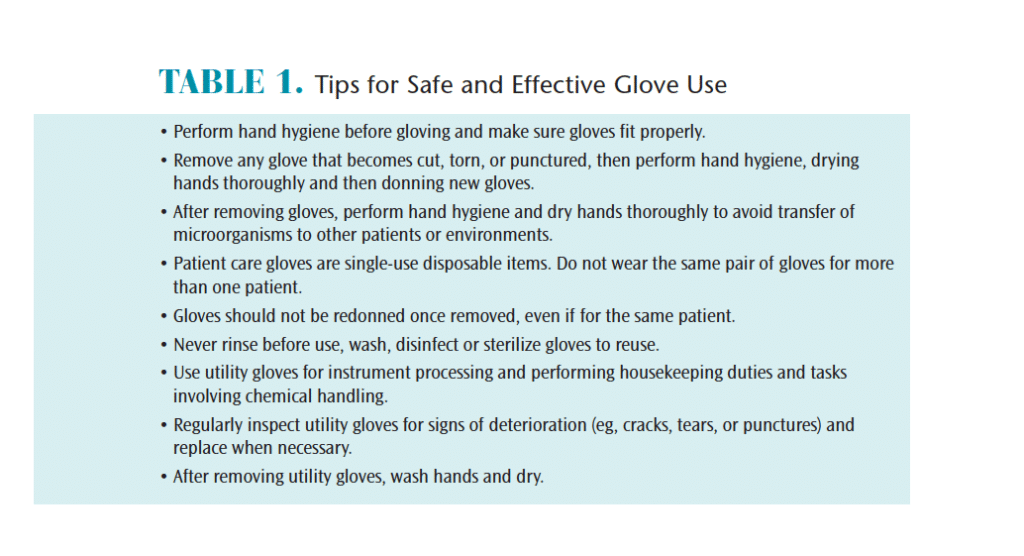
Hands are the master pathway of disease transmission. Hand hygiene is the most effective way to prevent the spread of infection, thus it must ever be washed prior to gloving.eight Routine hand washing with antiseptic hand wash, the use of antiseptic paw rub, or surgical paw antisepsis are all types of hand hygiene.10 Oral health professionals involved in patient care must be able to perform this task correctly and at the right fourth dimension. The use of gloves never replaces the need for cleaning hands.
Condom glove use includes accuracy in technique when donning (putting on) and doffing (removing) gloves (Figure 1 and Figure 2).11 Gloves are the last particular of PPE put on prior to patient handling and their removal follows a specific sequence. If any of these steps are non followed correctly, there is a high risk of peel contamination. Gloves must never be reused.
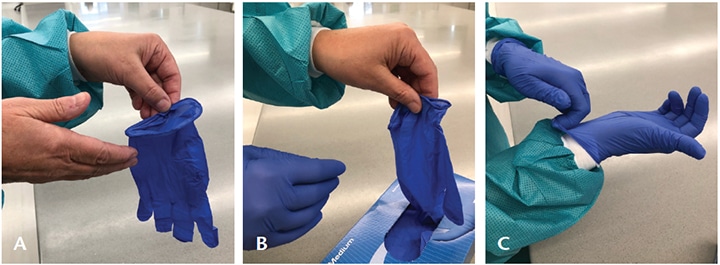
Occasionally during handling, a clinician must leave a patient to remember an instrument or device. If gloves aren't removed, cross-contamination can occur when touching other surfaces or items. Removing just one glove ways that bacteria on that hand could transfer to clean items. The best options are to apply a comprehend glove, or remove both gloves, perform manus hygiene, and then retrieve the detail.
Salubrious, intact skin is the best defence force against pathogen manual and infection. Choice and use of appropriate medical grade moisturizers and other hand hygiene products are necessary. In an effort to preclude dryness and contact dermatitis oft caused by frequent mitt hygiene, clinicians often apply lotions. However, lotions with a petroleum-base tin can hinder the effectiveness of latex gloves.x Therefore, oral health professionals should consider using only water-based lotions during the workday.
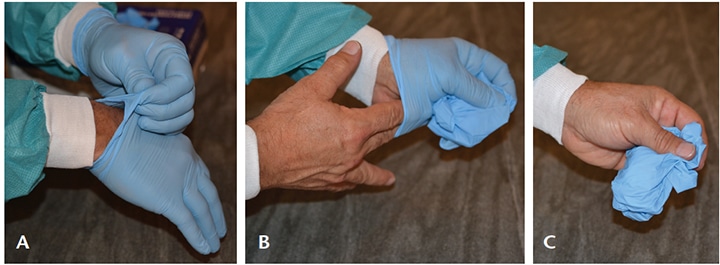
wrist level to remove it (A), without touching the skin of the forearm and peel abroad from the hand, thus allowing the
glove to plough within out. Hold the removed glove in the gloved hand and slide the fingers of the ungloved hand within
between the glove and the wrist (B). Remove the 2nd glove by rolling it downwardly the hand and fold into the first glove.
Discard the removed glove (C).11
Agin peel conditions can develop due to glove use, chemical exposure, and repeated paw hygiene. Allergies and sensitivities related to gloves should be evaluated past an allergist or dermatologist to pinpoint the cause and straight a course of treatment.
Long nails and manus jewelry can interfere with proper glove option, cause difficulty when donning, and are likely to create tears and/or punctures. Artificial nails are not recommended every bit they have been linked to outbreaks of bacterial infections. Natural nail tips should be kept less than a ¼ inch long.12
Gloves stored in areas with considerable moisture, lite, or heat are likely to degrade; shelf life varies by type and manufacturer.
Conclusion
Gloves are a critical component of PPE necessary for protection against bloodborne pathogens and exposure to other harmful pathogens. Proper hand hygiene along with the proper use of the right glove will dramatically reduce the likelihood of infection for both oral health professionals and patients. Dental hygienists must accept a clear understanding of advisable glove use in order to be confident they are providing the safest dental visit.
REFERENCES
- Aas JA, Paster BJ, Stokes LN, Olsen I, Dewhirst FE. Defining the normal bacterial flora of the oral crenel. J Clin Microbiol. 2005;43:5721–5732.
- Kramer A, Shwebke I, Kamft M. How long exercise nosocomial pathogens persist on inanimate surfaces? A systematic review. BMC Infect Dis . 2006;half-dozen:130.
- Bardorf MH, Jäger B, Boeckmans E, Kramer A, Assadian O. Influence of fabric properties on gloves' bacterial efficacy in the presence of microperforation. Am J Infect Control . 2022;44:1649–1649.
- Partecke LI, Goerdt AM, Langner I, et al. Incidence of micro perforation for surgical gloves depends on duration of vesture. Infec Control Hosp Epidemiol . 2009;30:409–414.
- Kohn WG, Collins AS, Cleveland JL, et al. Guidelines for Infection Control in Dental Health-Intendance Settings—2003. MMWR Recomm Rep . 2003;52(RR-17):one–76. x.
- United States Food and Drug Administration. Medical Device Bans. Available at: fda.gov/medicaldevices/rubber/medicaldevicebans/default.htm Accessed Nov 20, 2022.
- Organization for Condom, Asepsis and Prevention (OSAP). OSHA and CDC Guidelines: OSAP Interact Training System Workbook . Atlanta: OSAP; 2022.
- Summary of Infection Prevention Practices in Dental Settings: Basic Expectations for Safe Care. Atlanta: Centers for Illness Control and Prevention; 2022.
- Miller CH, Palenik CJ. Infection Control and Direction of Hazardous Materials for the Dental Team . 6th ed. St. Louis: Elsevier; 2022.
- United States Centers for Disease Command and Prevention. Hand Hygiene Frequently Asked Questions. Available at: cdc.gov/OralHealth/infectioncontrol/faq/hand.htm. Accessed November 20, 2022.
- Globe Health Organization. Glove Use Information Leaflet. Available at: who.int/gpsc/5may/Glove_Use_Information_Leaflet.pdf. Accessed Nov 20, 2022.
- Boyce JM, Pittet D; Healthcare Infection Command Practices Advisory Committee. Society for Healthcare Epidemiology of America. Association for Professionals in Infection Control. Infectious Diseases Society of America. Manus Hygiene Task Force. Guideline for Hand Hygiene in Health-Care Settings: recommendations of the Healthcare Infection Command Practices Advisory Committee and the HICPAC/SHEA/APIC/IDSA Manus Hygiene Job Force. Infect Control Hosp Epidemiol. 2002;23(12 Suppl):S3–S40.
FromDimensions of Dental Hygiene. Dec 2022;16(12):23–25.

Source: https://dimensionsofdentalhygiene.com/article/safe-effective-use-gloves/
Posted by: feltonandesch.blogspot.com
0 Response to "Can Clean Gloves Be Worn Outside Dental Operatory"
Post a Comment